Impact of convective limitations on heat-health outcomes
I am currently investigating how atmospheric convection limits the exceedance of human health thresholds under extreme heat. This work combines our current understanding of physiological heat thresholds with convective limitations on extreme heat to better understand and predict impacts on human health.
Role of ocean circulation for Arctic and global climate
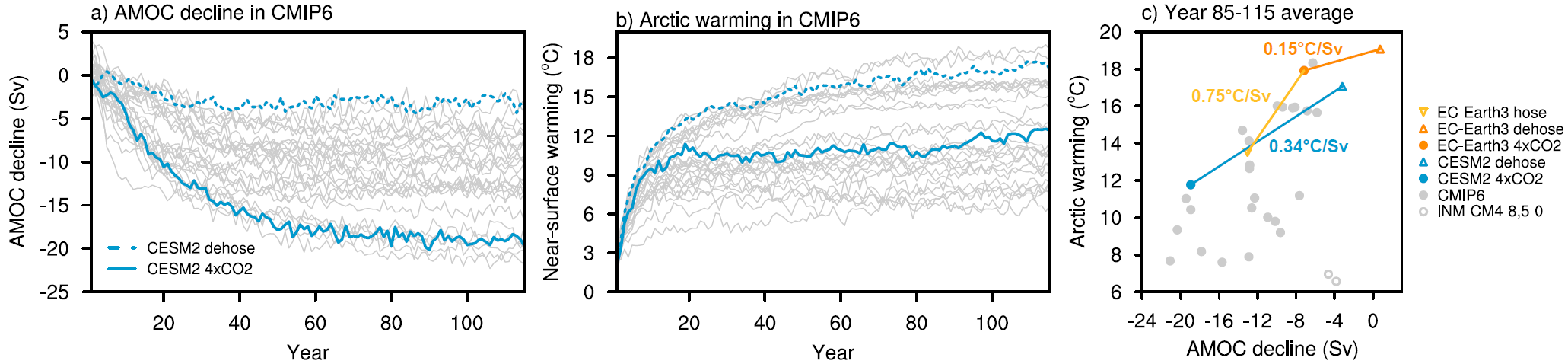
Global climate models vary widely in their projections of 21st century surface warming as a result of spread not only in radiative forcing and feedbacks, but also in ocean heat uptake. In particular, the degree of near-future warming is mediated by the Atlantic Meridional Overturning Circulation (AMOC). My postdoctoral research has used idealized model experiments to show that model uncertainty in AMOC projections can reproduce 20% of the total uncertainty in global warming and 45% of the uncertainty in Arctic warming by controlling ocean heat uptake and climate feedbacks. This research indicates that uncertainty in warming projections may be substantially reduced by constraining projections of the AMOC.
Related Publications:
Hahn, L. C., Eisenman, I., Lutsko, N. J., Meccia, V., Mehling, O., and Bellomo, K. (2025), Large Uncertainty in Arctic Warming Driven by the Atlantic Meridional Overturning Circulation. Geophysical Research Letters, 52, e2025GL119720. https://doi.org/10.1029/2025GL119720
Hahn, L. C., Lutsko, N. J., Eisenman, I., Luongo, M. T., and Xie, S.-P. (2025), Contribution of AMOC Decline to Uncertainty in Global Warming via Ocean Heat Uptake and Climate Feedbacks. J. Climate, 38, 6245–6259. https://doi.org/10.1175/JCLI-D-24-0752.1
Ren, Q., Xie, S.-P., Hahn, L. C., Hu, A., Miyamoto, A., Wang, F., and Li, Y. Indo-Pacific ocean heat transport lessens Atlantic Meridional Overturning Circulation effect on tropical rainfall. Submitted, 2026.
Mechanisms of Polar Amplification
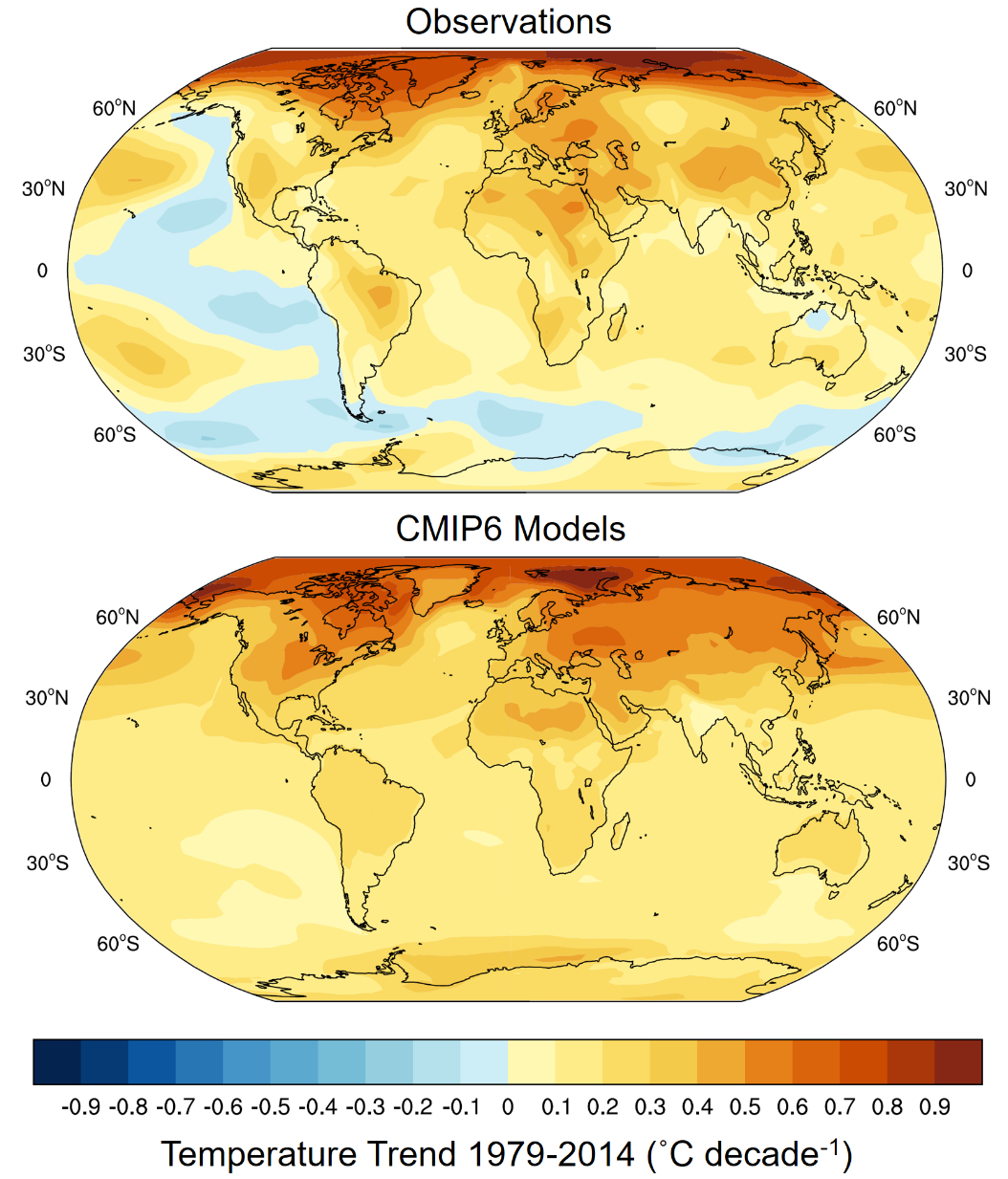
The Arctic has warmed four times faster than the global average in recent decades. This polar-amplified warming has important impacts on local ecosystems and global climate. Yet there is still debate over the drivers of polar amplification, and future warming uncertainty is larger for the polar regions than for any other region on Earth. As a window into the mechanisms of polar amplification, my PhD work explores its hemispheric and seasonal asymmetries: why does Arctic warming outpace Antarctic warming, why does the Arctic warm more in winter than in summer, and what are the causes and implications of seasonal changes in poleward heat transport? I use climate models of varying complexity and observations to identify fundamental mechanisms of polar climate change and its asymmetries.
Related Publications:
Hahn, L. C., K. C. Armour, D. S. Battisti, A. Donohoe, and R. Fajber (2023), Seasonal changes in atmospheric heat transport to the Arctic under increased CO2. Geophysical Research Letters, 50, e2023GL105156.
Hahn, L. C., K. C. Armour, D. S. Battisti, I. Eisenman, and C. M. Bitz (2022), Seasonality in Arctic Warming Driven By Sea Ice Effective Heat Capacity. J. Climate, 35, 1629-1642.
Hahn, L. C., K. C. Armour, M. D. Zelinka, C. M. Bitz, and A. Donohoe (2021), Contributions to Polar Amplification in CMIP5 and CMIP6 Models. Frontiers in Earth Science, 9, 710036.
Hahn, L. C., K. C. Armour, D. S. Battisti, A. Donohoe, A. G. Pauling, and C. M. Bitz (2020), Antarctic elevation drives hemispheric asymmetry in polar lapse rate climatology and feedback. Geophysical Research Letters, 47, e2020GL088965.
Extratropical Clouds and Climate
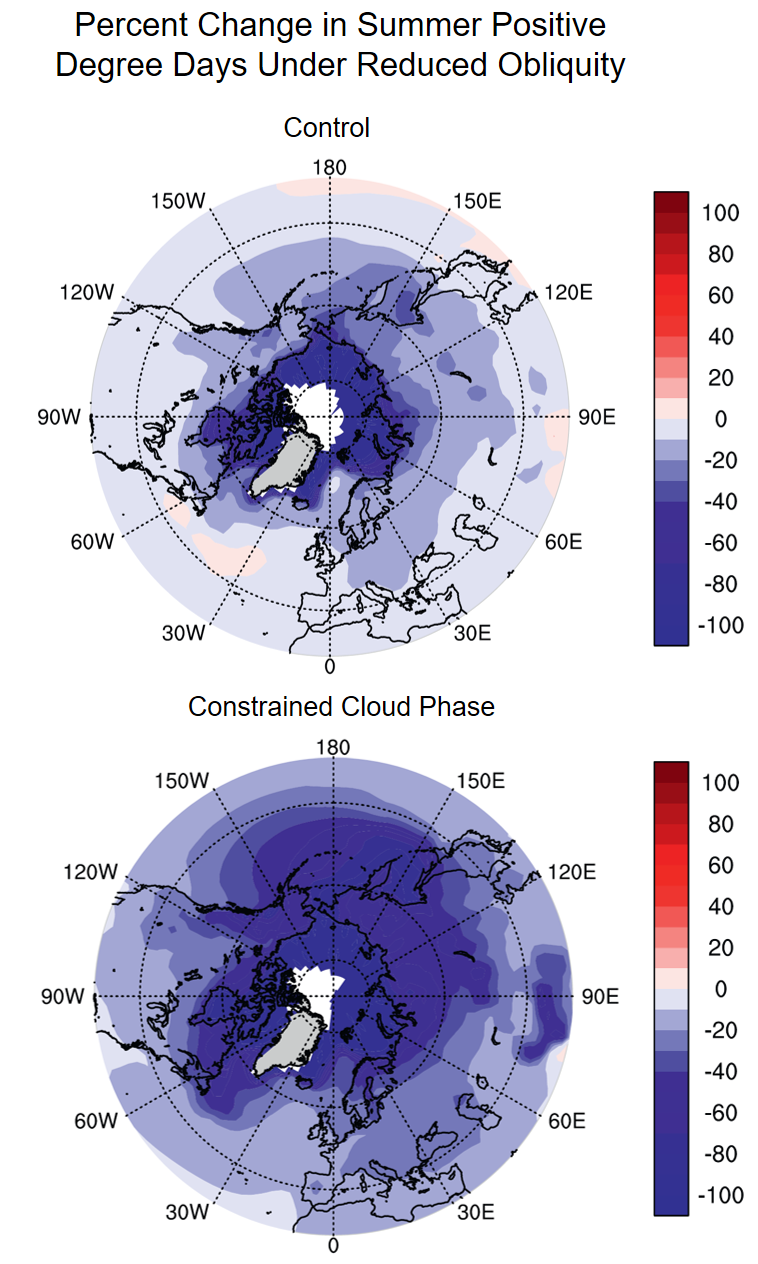
Clouds play an important role in the climate response to external forcing and internal variability. Using reanalysis data, satellite observations, and a regional climate model, I investigated the role of clouds as a link between high-pressure anomalies and Greenland melt. I found that high-pressure circulation anomalies interact with Greenland topography to produce regionally-varying cloud changes that increase melting across the Greenland ice sheet. In other collaborations, we have found an important role of the cloud-phase feedback for both local and remote warming under CO2 forcing. We have also studied the role of cloud phase for the climate response to orbital forcing: constraining cloud phase with observations produces feedbacks that more strongly amplify orbital climate forcing in model experiments and support ice sheet expansion consistent with proxy records.
Related Publications:
Hofer, S., Hahn, L.C., Shaw, J.K. et al. (2024), Realistic representation of mixed-phase clouds increases projected climate warming. Communications Earth and Environment, 5, 390. https://doi.org/10.1038/s43247-024-01524-2
Sagoo, N., T. Storelvmo, L. Hahn, I. Tan, and A. J. Broccoli (2021), Observationally Constrained Cloud Phase Unmasks Orbitally Driven Climate Feedbacks. Geophysical Research Letters, 48, e2020GL091873.
Hahn, L. C., T. Storelvmo, S. Hofer, R. Parfitt, and C. C. Ummenhofer (2020), Importance of orography for Greenland cloud and melt response to atmospheric blocking. J. Climate, 33, 4187-4206.
Community Science
Community science broadens access to science and addresses community-driven priorities by fostering collaboration between scientists and community leaders. I have led community science initiatives through the American Geophysical Union's Thriving Earth Exchange and the Actionable Community-Oriented Research eNgagement (ACORN) program within the Program on Climate Change at the University of Washington.

Related projects:
I recently became a Community Science Fellow with the Thriving Earth Exchange. As a Fellow, I am excited to engage with communities and scientific partners to facilitate community science in a project management role.
Through the Thriving Earth Exchange, I worked with a team of four volunteer scientists and two community leaders on a feasibility study for accelerated expansion of renewable energy in Arlington, Virginia. I estimated emissions reductions and led the environmental benefits chapter of this study, which was shared broadly with the local community.
Through PCC ACORN, I worked with the Washington State Department of Commerce and Utilities and Transportation Commission to estimate the emissions impacts of various energy strategies and policy scenarios. This work will be used to inform future energy targets and increase participation in emissions-reducing programs.